

MUZEOLÓGIA
MUSEOLOGY
a kultúrne dedičstvo
and Cultural Heritage

News
Journal Muzeológia a
kultúrne dedičstvo -
Museology and Cultural
Heritage:
SJR 2025: 0,425 (Q1)
Museology SJR rank: 6/101 (Q1) Conservation SJR rank: 12/113 (Q1)JIF WoS 2025: 1,0
JCI WoS 2025: 1,22, Q1 ESCI: 33/403 (Q1)New issue
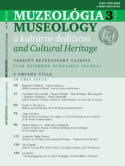
Muzeológia a kultúrne
dedičstvo 3/2026
online New volume Studia Museologica Slovaca, vol. 9 (2025) online New volume Populačné štúdie Slovenska 19 (2025) onlineNew book
L. Jagošová a P. Tišliar (eds.). Kapitoly z dějin uměleckoprůmyslového muzejnictví (2025) online
Contents 1/2026
Title: Heritage-making as artistic practice? Mateusz Okoński’s cabinet of curiosities as fleeting
heritage
Abstract: Is it possible to create heritage through artistic practice? The authors ask this question through the perspective of the work
of Mateusz Okoński, a Polish mid-career artist and exhibition designer whose passion for collecting has resulted in the creation of a
cabinet of curiosities at his private apartment in Kraków. The discussion in the article encompasses the practice of the collection’s
creation, the temporality of the objects and the collection itself, the authenticity of the cabinet of curiosities, and also the various multi-
sensory narratives which are offered by the artist to those who visit his salon. The authors investigate whether such collecting and the
resulting cabinet of curiosities comprises heritage or whether it is merely an act of collecting historic objects, and conclude that
heritage-making can be the result of artistic practice.
Authors: Katarzyna Jagodzińska1; John Beauchamp2
Publication order reference:
1 Jagiellonian University, Faculty of International and Political Studies, Institute of European Studies, ul. Władysława Reymonta 4, 30-059 Kraków, Poland, e-
mail: katarzyna.jagodzinska@uj.edu.pl, https://orcid.org/0000-0003-2290-410X
2 Jagiellonian University, Doctoral School in the Humanities, Rynek Główny 34, 31-010 Kraków, Poland, e-mail: john.beauchamp@doctoral.uj.edu.pl,
https://orcid.org/0009-0006-0782-6675
Source: Muzeológia a kultúrne dedičstvo, year: 2026, vol.: 14, issue: 1, pages: 5–28.
Keywords: heritage-making, cabinet of curiosities, Mateusz Okoński, contemporary art
Language: English
online full-text PDF
doi: 10.46284/mkd.2026.14.1.1
Title: Museum Diplomacy in Ukraine During the Russian Full-scale Invasion
Abstract: This article explores museum diplomacy during armed conflict, focusing on the international cooperation of Ukrainian
museums amid Russia’s full-scale invasion. It highlights the expanding role of museums as diplomatic and political actors, balancing
state-led objectives with independent cultural initiatives. A case study of the War Museum in Kyiv analyses its international exhibitions
as instruments of museum diplomacy, demonstrating their role in shaping global perceptions of the war and mobilising solidarity with
Ukraine.
Authors: Elżbieta Olzacka1
Publication order reference:
1 Jagiellonian University, Faculty of Philosophy, Institute of Comparative Studies of Civilisations, Poland, e-mail: elzbieta.olzacka@uj.edu.pl,
https://orcid.org/0000-0002-8025-9199
Source: Muzeológia a kultúrne dedičstvo, year: 2026, vol.: 14, issue: 1, pages: 29–47.
Keywords: museum diplomacy, war, Ukraine, Russian invasion, war museum
Language: English
online full-text PDF
doi: 10.46284/mkd.2026.14.1.2
Title: Inclusive Customer Journey in Museums: Enhancing the Museum Visitor Experience for
Generation Z individuals with Specific Learning Disorders
Abstract: Despite their significance as institutions of cultural preservation and education, many museums remain inaccessible to
individuals with specific learning disorders (SpLDs), particularly Gen Z, who may face challenges in processing visual cues. This study
explores the barriers that Gen Z individuals with SpLDs encounter in art museums. Through semi-structured interviews and eye-
tracking studies, the research identifies key pain points. The article outlines barriers in museums, highlighting Gen Z’s perceptions and
experiences. It features a case study of visitor journeys during an exhibition at Gočár Gallery in Pardubice, Czechia, offering
recommendations for fostering a more inclusive and enriching museum experience.
Author: Eva Vázalová Gartnerová1; Josef Kocourek2; Martina Juříková3; Romana Zábojová4
Publication order reference:
1 Tomas Bata University in Zlin, Faculty of Multimedia Communications, Univerzitní 2431, Zlín, Czechia, e-mail: gartnerova@utb.cz, https://orcid.org/0000-
0002-0225-2696
2 Tomas Bata University in Zlin, Univerzitní 2431, Zlín, Czechia, e-mail: kocourek@utb.cz, https://orcid.org/0000-0002-5793-6278
3 Tomas Bata University in Zlin, Faculty of Multimedia Communications, Univerzitní 2431, Zlín, Czechia, e-mail: jurikova@utb.cz, https://orcid.org/0000-0001-
8587-9058
4 Tomas Bata University in Zlin, Faculty of Multimedia Communications, Univerzitní 2431, Zlín, Czechia, e-mail: zabojova@utb.cz, https://orcid.org/0009-0008-
9063-2840
Source: Muzeológia a kultúrne dedičstvo, year: 2026, vol.: 14, issue: 1, pages: 49–67.
Keywords: audience, specific learning disorders, Gen Z, museum, accessibility
Language: English
online full-text PDF
doi: 10.46284/mkd.2026.14.1.3
Title: Cultural heritage of the Argentine Polish community in the collection
of the Polish Army Museum in Buenos Aires
Abstract: The Polish Army Museum in Martin Coronado, a town in in Buenos Aires province, is the only museum in South America
dedicated to promoting Polish historical and cultural heritage. The museum houses a collection of unique memorabilia that serve to
preserve the memory of Polish soldiers and make a valuable contribution to the preservation and dissemination of Polish cultural
heritage. The Polish historical and cultural heritage in Argentina is extremely rich and has a long tradition dating back to the nineteenth
century, when the first Poles began to settle on Argentinian lands. By advocating for Polish cultural heritage beyond the borders of
Poland, the museum not only helps prevent it from being forgotten but also enriches the world’s cultural heritage.
This article analyses the activities of the Polish Army Museum in Buenos Aires by presenting the origins of its establishment; the
characteristics and organisation of its collection; the methods used for storage, cataloguing and exhibiting; and the results of the
inventory of 1,502 exhibits (as of January 2025). Additionally, the article aims to highlight the role of the museum as an institution
responsible for the protection, documentation, and promotion of Polish historical and cultural heritage in Argentina as well as its
significance in shaping historical memory.
Authors: Kamila Ziółkowska-Weiss1; Jerzy Jacek Tworóg2
Publication order reference:
1 University of the National Education Commission, Institute of Law, Economics and Administration, Department Podchorążych St.2/537, 30-084 Kraków,
Poland, e-mail: kamila.ziolkowska-weiss@uken.krakow.pl, https://orcid.org/0000-0001-6575-5314
2 Uniwersytet Kardynała Stefana Wyszyńskiego w Warszawie, Dewajtis St.5, 01-815 Warszawa, Poland, e-mail: jurek@fibertel.com.ar, https://orcid.org/0009-
0000-7625-7222
Source: Muzeológia a kultúrne dedičstvo, year: 2026, vol.: 14, issue: 1, pages: 69–90.
Keywords: cultural heritage, Argentine Polish community, history of Poland, Polish Army Museum, Buenos Aires
Language: English
online full-text PDF
doi: 10.46284/mkd.2026.14.1.4
Articles (Abstracts)
Full-text version
DOI:10.46284/mkd.2026.14.1.0
ISSN 1339-2204
eISSN 2453-9759
EV 1/22/EPP
Vol. 14 (2026), No. Is. 1
Published: 1.3.2026


